

Thunderpick Casino 2026: Does a Casino Inside a Crypto Esports Ecosystem Make Sense?
Thunderpick is often mentioned as one of the early attempts to combine esports betting, cryptocurrency payments, and a full-scale online casino under one brand. By 2026, this hybrid model has become more common, but it still raises a practical question: does it actually benefit players, or is it simply a branding layer built around trends? This review looks at how Thunderpick operates today, what role the casino section plays within its broader ecosystem, and whether this integration creates real value or unnecessary complexity.
How Thunderpick Positions Itself in 2026
Thunderpick originally focused on esports betting, offering markets on titles such as CS2, Dota 2, and League of Legends. Over time, it expanded into a full casino offering, including slots, live dealer games, and crypto-friendly payment systems. By 2026, the brand presents itself not as a traditional gambling site but as a combined environment where esports fans can also access casino entertainment without leaving the same account.
The key difference lies in its crypto-first infrastructure. Deposits and withdrawals are primarily handled through Bitcoin, Ethereum, and stablecoins, with limited support for fiat currencies depending on jurisdiction. This approach reduces transaction delays but also introduces volatility risks, which players need to consider when managing balances.
Another defining feature is the integration between esports betting and casino activity. Promotions, bonuses, and loyalty systems are often shared across both sections. This means that a player placing bets on esports tournaments may receive rewards that can be used in casino games, creating a unified experience rather than two separate products.
What Makes the Ecosystem Model Different
The idea of combining esports and casino content is not entirely new, but Thunderpick attempts to link them more directly than most competitors. Instead of treating casino games as an additional category, it builds cross-activity incentives, encouraging users to move between betting and gaming.
This model can be practical for users who already engage with esports regularly. They do not need to register on multiple sites or manage separate balances. However, for players who are only interested in casino games, the esports focus may feel unnecessary and add complexity to navigation and promotions.
There is also a behavioural aspect to consider. When different gambling formats are combined within one account, it becomes easier for users to switch between them quickly. While convenient, this can lead to less controlled spending patterns if not approached with discipline.
Casino Offering: Depth, Providers and RTP Reality
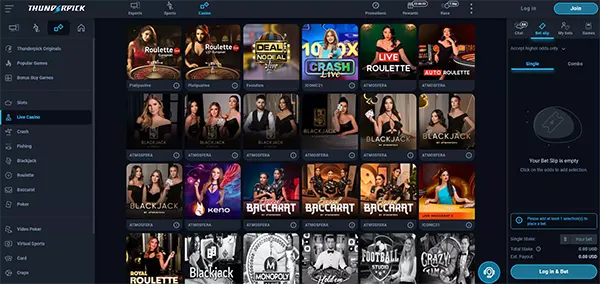
By 2026, Thunderpick’s casino library includes several thousand games from well-known providers such as Pragmatic Play, Evolution, NetEnt, and Play’n GO. The selection covers standard categories: video slots, table games, and live dealer studios. From a technical perspective, the casino section is comparable to many mid-to-large operators on the market.
Return-to-player (RTP) values generally align with industry averages. Most slots fall within the 94%–96.5% range, depending on the provider and specific game version. It is important to note that RTP is theoretical and calculated over long sessions, not short-term play. Thunderpick does not significantly alter these figures but relies on standard provider configurations.
Live casino games, particularly blackjack and roulette, follow established rulesets. The house edge remains consistent with global standards, meaning there is no clear mathematical advantage compared to other operators. The main distinction is not in game mechanics but in how access and payments are structured through crypto systems.
Bonuses and Wagering: Practical Perspective
Thunderpick offers bonuses that often combine esports and casino requirements. For example, a welcome package may include both betting credits and free spins. While this sounds flexible, it can complicate wagering conditions, as players must meet different requirements across multiple sections.
Wagering requirements in 2026 typically range from 30x to 50x for casino bonuses. This is within industry norms, but players should carefully read terms, especially regarding maximum bet limits and game contribution percentages. Some slots contribute fully, while table games often contribute less or are excluded entirely.
From a usability standpoint, bonuses are not always intuitive. The combination of crypto values, fluctuating exchange rates, and mixed wagering rules can create confusion. Players benefit from tracking their progress manually rather than relying solely on automated displays.
Crypto Payments, Security and Regulatory Position
One of Thunderpick’s strongest points remains its approach to crypto transactions. Deposits are typically processed within minutes, while withdrawals depend on blockchain confirmation times but are generally faster than traditional banking methods. This makes it attractive for users who prioritise speed and privacy.
However, cryptocurrency introduces its own risks. Price volatility can affect both deposits and winnings. A balance held in Bitcoin may lose or gain value independently of gameplay results. For some players, this adds an extra layer of uncertainty that does not exist with fiat currencies.
From a regulatory perspective, Thunderpick operates under offshore licensing, which is common among crypto-focused operators. While this allows for broader accessibility, it also means that consumer protections may differ from those offered by strictly regulated European markets. Players should be aware of dispute resolution limitations and verify terms before committing funds.
Does the Model Work for Players in Practice?
The combined esports and casino model works best for a specific audience: users who are already familiar with esports betting and comfortable using cryptocurrency. For them, Thunderpick offers convenience and a single environment for multiple activities.
For traditional casino players, the advantages are less clear. The crypto-first approach may feel restrictive, and the esports integration does not necessarily improve the core gaming experience. In such cases, simpler operators with fiat support may be more practical.
Overall, Thunderpick represents a functional but niche solution. It demonstrates how gambling services are evolving alongside esports and blockchain technology, but its value depends heavily on user preferences rather than offering a universal improvement over standard casino formats.