
Shuffle Casino: Do SHFL Lottery and Originals Offer a Different Kind of Value for Crypto Players?
Shuffle Casino has positioned itself as a crypto-focused gaming environment where traditional bonus logic is partly replaced by token-based mechanics and in-house game development. By 2026, the project has attracted attention not only for its design but for how it integrates SHFL token distribution, lottery systems, and proprietary Originals into a single economic loop. This article examines whether these elements genuinely create a different type of value for players or simply repackage familiar incentives in a new format.
How the SHFL Token Economy Changes Player Incentives
The SHFL token is central to Shuffle Casino’s ecosystem. Unlike standard reward points found in many crypto casinos, SHFL operates as a blockchain-based asset that can be earned through gameplay, staking, and participation in promotional activities. Its value is tied not only to in-casino use but also to broader market dynamics, which introduces an additional layer of financial consideration for players.
From a practical standpoint, players are not just wagering for short-term returns but are indirectly participating in a token distribution model. This changes behaviour patterns: some users focus on long-term accumulation rather than immediate withdrawals, treating SHFL as a speculative asset. In 2026, this hybrid approach—part gaming, part token exposure—has become more common across crypto gambling projects, but Shuffle remains one of the clearer examples.
However, the model is not without risk. Token volatility can impact perceived value significantly. A reward earned today may fluctuate in value tomorrow, meaning players need to understand both gambling mechanics and basic crypto market behaviour. This dual exposure makes the system more complex than traditional loyalty schemes.
The Role of Staking and Passive Rewards
One of the defining features of the SHFL ecosystem is staking. Players can lock their tokens to receive a share of platform revenue or additional rewards. This introduces a passive income element that is absent in conventional casinos, where rewards are typically limited to bonuses or cashback.
Staking creates a longer-term relationship between the player and the casino. Instead of engaging only during gameplay sessions, users may remain invested due to ongoing yield generation. In 2026, this model reflects broader trends in decentralised finance, where users expect assets to generate returns rather than remain idle.
That said, staking also introduces opportunity cost. Tokens locked in staking cannot be immediately used for gameplay or withdrawn, which may limit flexibility. For players who prioritise liquidity, this can be a drawback rather than an advantage.
SHFL Lottery: Randomised Rewards or Strategic Layer?
The SHFL lottery system adds another dimension to the platform. Instead of purely skill-based or RNG-driven games, the lottery introduces scheduled draws where participation is linked to activity on the casino. Tickets are often distributed based on wagering volume or specific actions, aligning rewards with engagement.
From a design perspective, this system encourages consistent activity rather than isolated sessions. Players who engage regularly accumulate more entries, increasing their chances of winning. In 2026, such mechanics are widely used to improve retention, but Shuffle integrates them directly with its token economy, making rewards potentially more meaningful.
At the same time, the lottery remains fundamentally probabilistic. While it may appear as an additional earning channel, outcomes are still governed by chance. For players expecting predictable returns, this can lead to misaligned expectations if the lottery is viewed as a reliable income stream.
Transparency and Fairness in Lottery Mechanics
One of the key concerns around lottery systems is transparency. Shuffle Casino addresses this by using provably fair mechanisms and blockchain verification where applicable. Players can often verify draw results and understand how winners are selected, which helps build trust.
In 2026, transparency has become a baseline expectation in crypto gambling. Projects that fail to provide verifiable fairness tend to lose credibility quickly. Shuffle’s approach aligns with industry standards, offering users a clearer view of how outcomes are generated.
Despite this, transparency does not eliminate variance. Even with fully verifiable systems, the distribution of rewards can be uneven. A small number of players may capture large payouts, while others see minimal returns, which is typical for lottery-based mechanics.
Originals by Shuffle: Control Over Game Design and RTP
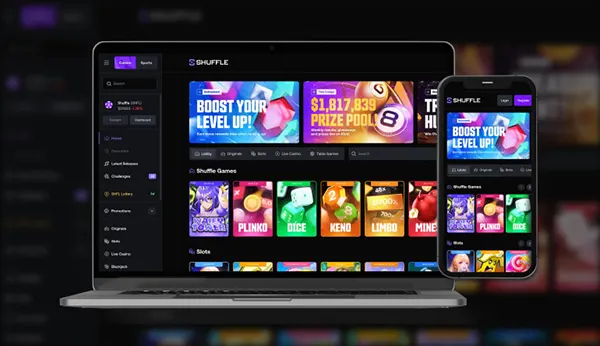
Shuffle Originals represent the platform’s in-house game portfolio. Unlike third-party slots or table games, these titles are developed internally, allowing the casino to control mechanics, return-to-player (RTP) settings, and integration with the SHFL ecosystem. This level of control enables tighter alignment between gameplay and token rewards.
In practice, Originals often feature faster gameplay cycles, simplified interfaces, and direct reward integration. For example, certain games may contribute more heavily to SHFL earnings or lottery entries, making them strategically important within the platform. This creates a distinct environment compared to traditional casinos, where games are largely isolated from reward systems.
By 2026, proprietary games have become a competitive advantage for many crypto casinos. They allow operators to differentiate their offering and experiment with mechanics that would not be possible with external providers. Shuffle uses this flexibility to reinforce its ecosystem rather than rely solely on standard game libraries.
Do Originals Provide Real Value or Just Internal Looping?
The key question is whether Originals genuinely enhance player value or simply keep activity within the platform. On one hand, they offer smoother integration with rewards, faster feedback loops, and a more cohesive experience. Players who understand the system can optimise their gameplay to maximise benefits.
On the other hand, the closed nature of proprietary games means that value is largely contained within the Shuffle ecosystem. Unlike widely recognised slots or table games, Originals do not have external benchmarks, making it harder to compare RTP or volatility across platforms.
For informed players, this means additional analysis is required. Understanding how each game contributes to SHFL earnings, lottery participation, and overall return becomes essential. Without this, it is easy to overestimate the benefits of the system and overlook its underlying structure.